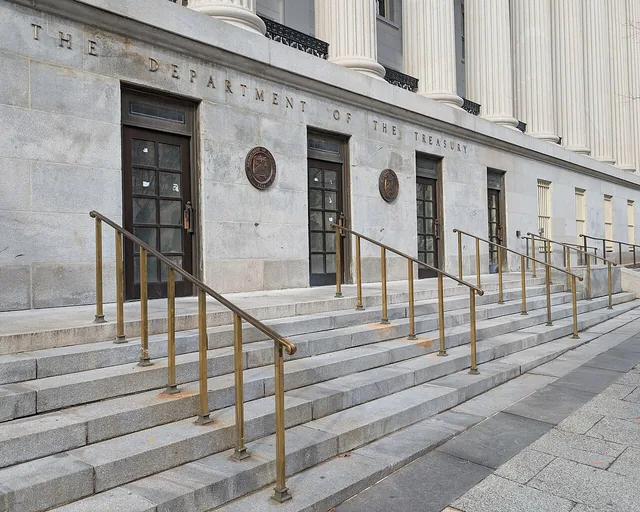
The United States announced a sanctions campaign against Iran on Monday that its own Treasury Secretary named after the Normandy landings. Scott Bessent called it Operation Economic Outcast and drew the comparison himself: in the Second World War, he said, D-Day began a campaign with allies to drive the enemy from its positions, including in third countries, and in that same spirit the United States was launching an economic onslaught against Iran's financial connections around the globe. The stated aim, CBS News reports, is to reopen the Strait of Hormuz and end the war.
What was actually issued is narrower than the framing. The Treasury made determinations against five sectors — digital assets, technology, gold, aviation and shipping — and, BBC reports, imposed sanctions on almost sixty entities, individuals and vessels. The larger instrument is secondary sanctions: any bank or business that keeps dealing with Iran shares its isolation, and anyone laundering money on Iran's behalf, Bessent said, will be removed from the dollar system.
Then he slowed it down. Many of the secondary measures are not immediate. "We are giving everyone the opportunity to remedy bad behaviour," he told reporters, and asked why he would want to blow up the global financial system; there would be a cure period, but people should know Washington would move very quickly. He said he expects a major financial institution to be sanctioned by the end of the week, that Iran's Bank Melli "must be shuttered and dark", and that Trump is telephoning world leaders with specific requests to cut their dealings. He declined to name any country. Asked whether Chinese banks financing Iranian oil would be hit, he said no one is above the reach of US sanctions, and called trade with Iran — including by Gulf allies — appeasement.
Tehran's answer came within hours. The economy minister, Ali Madanizadeh, said Iran was fully prepared and that the measures would produce another defeat for the United States. He said neither China nor Russia had accepted them and predicted others would resist, that the government had a two-year plan for exactly this, and that Iran had its own tools and knew how to play the game. China's foreign ministry said sanctions and pressure do not help and that Beijing would do what was necessary to protect its interests. Iran also warned it would shut all oil exports from the region if the war continued, and, according to Reuters cited by BBC, told ships not to pass through the Strait of Hormuz without permission.
That last point is where the campaign meets the thing it is meant to fix. A fifth of the world's oil and gas normally moves through the strait, and the flow has been effectively blocked since the war began at the end of February. One of Iran's largest trading partners, the United Arab Emirates, said last week it was suspending financial and economic transactions with Tehran.
Not everyone reads the announcement as decisive. Brett Erickson, a Washington sanctions specialist quoted by CBS News, said it was not economic D-Day but something in the middle, and that the binding constraint is whether Washington is willing to target China at all.
Why it is on the board
Top of BBC's most-read list when we collected, with a clip on the announcement in the British video lens.
The two accounts we hold divide by which end of the announcement they stood at. CBS News was in the room: the operation's name, the D-Day sentence, the cure period, the questions Bessent declined to answer. BBC took the announcement to Tehran and Beijing and came back with the replies, the trading-partner list, and the number of names actually sanctioned. The British board is reading the second one.
확인: BBC · CBS News