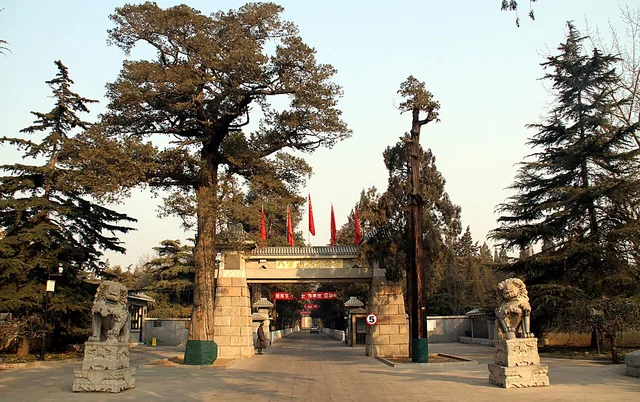
The body of Zhu Rongji, premier of China's State Council from 1998 to 2003, was cremated at the Babaoshan Revolutionary Cemetery in Beijing on 18 August. Xinhua reported that at about half past nine that morning Xi Jinping, Li Qiang, Zhao Leji, Wang Huning, Cai Qi, Ding Xuexiang, Li Xi and Han Zheng walked to the body as funeral music played, stood in silence, bowed three times and shook hands with the family. Hu Jintao sent a wreath.
The hall was described in the same report: a black banner with white characters reading "deep mourning for Comrade Zhu Rongji", his portrait beneath it, and the body lying among flowers and cypress under the red flag of the Communist Party.
Zhu died in Beijing on 12 August at six minutes past eleven in the morning, aged 98.
On the day of the cremation Xinhua also released his official life. It runs through a career that begins with electrical machinery at Tsinghua from 1947 to 1951 and, between 1970 and 1975, a spell of manual labour at a cadre school after he was sent down. He held the posts of deputy party secretary, mayor and party secretary in Shanghai from December 1987 to April 1991, became a vice premier that April, entered the Politburo Standing Committee in October 1992, took on the governorship of the People's Bank of China in June 1993, and was appointed premier at the first session of the ninth National People's Congress in March 1998.
The document is specific about what it credits him with. In Shanghai: the restructuring of industry, the opening of the Shanghai stock exchange, and the first rollout in the country of the housing provident fund. In Beijing before he was premier: the clearing of the chain of unpaid debts between enterprises, and the measures that cooled an overheating economy into what the text calls a soft landing. As premier: holding the currency against devaluation through the Asian financial crisis and severe floods, and a move from a moderately tight fiscal and monetary policy to an active fiscal policy and a prudent monetary one.
It also records what came after. He ceased to be premier in March 2003. The text says he gave the whole of the income from his books to poverty relief and to schooling, and that he set himself three rules covering domestic inspections, the trimming of meetings and attendance at ceremonial events.
Why it is on the board
It was the most-read item in China that day by our count — first on Weibo's hot search list and second and fourth on Baidu's. What people were reading was not the funeral. The phrase at the top of the lists was the biography itself.
One other thing our lists show for the same day: the housing provident fund, the Shanghai policy the biography credits to him, was third on Weibo under its own name.
확인: 新华社