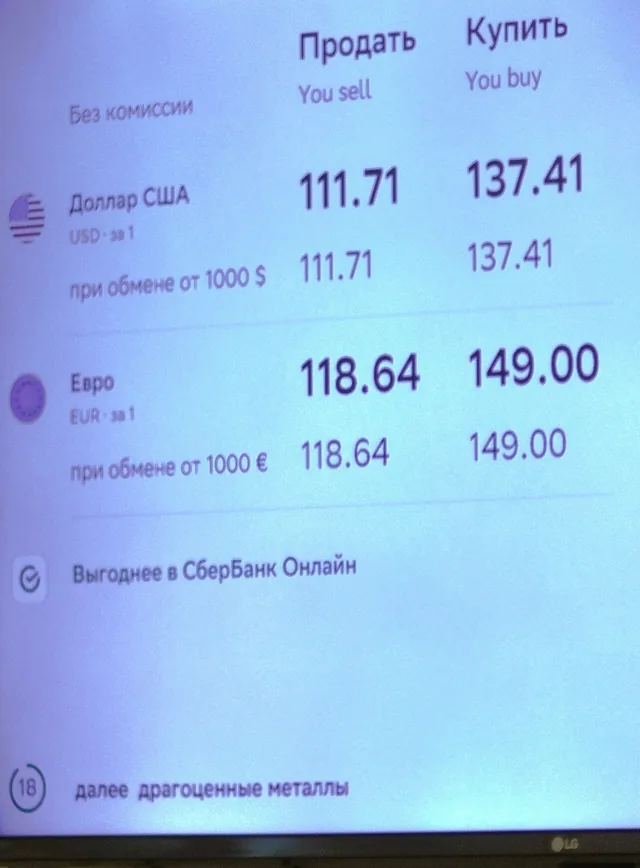
Money is leaving Russian bank accounts faster than it did in the first year of the war. Russian central bank figures, reported by the Washington Post, show 286.4 billion roubles — roughly 2.9 billion euros — taken out in the first two weeks of August alone. July accounted for about 6.3 billion euros, June for about 3.89 billion. n-tv puts the total drained from the banking system since the start of the year at around 24 billion euros, more than the roughly 20 billion withdrawn during the whole first year after the invasion of February 2022.
Two fears run through the accounts given to the Post. One is the Ukrainian drone campaign against refineries and logistics sites inside Russia. The other is that the state itself will reach for private deposits to pay for the war. A former senior Russian finance official described to the paper drones flying, things burning down, and nervousness growing.
Taras Skvortsov, Sberbank's finance chief, told analysts on a call that customers were reacting to public talk of possible confiscation, pointing to remarks by well-known politicians. He also warned of liquidity shortfalls. Banks lent heavily to defence production under government pressure, are carrying bad loans, and are the main domestic buyers of state debt. The finance ministry has had to cancel planned bond sales even as the budget gap widens — 6.46 trillion roubles between January and July, against 3.8 trillion originally planned for the whole year.
n-tv also carried a caveat. Yegor Susin, an economist at state-controlled Gazprombank, calculates that about half of July's rise in cash holdings is seasonal. He also sees a return to a longer-run trend: the higher interest rates of before had pushed cash holdings to an unusually low level. The central bank's key rate now stands at 14 per cent.
Alexandra Prokopenko, a former adviser to the Russian central bank who now works at the Carnegie Russia Eurasia Center in Berlin, told the Post that Russians no longer trust the banking system. She considers outright nationalisation of deposits unlikely, but does not rule out limits on withdrawals.
Recent seizures are a matter of record. Der Spiegel notes that Russia nationalised assets worth about 6.5 trillion roubles — some 72 billion euros at the time — between 2022 and the end of 2025. In June the state took holdings worth 7.6 billion dollars linked to Vadim Moshkovich, founder of the agricultural group Rusagro, the largest single confiscation since the invasion began. Companies are moving money out as well: more than 9.4 billion dollars left the banking system in the second quarter. And Andrei Klepach, chief economist at the state development bank VEB, was dismissed after his May warning that Russia cannot win a war of attrition became public.
Why it is on the board
Fourth on Der Spiegel's most-read ranking when we collected, and on n-tv's list as well — two of the three German reading lists this board can see, on the same morning. Note what German readers were reading: not a German story at all, and sourced from an American newspaper.
확인: Der Spiegel · n-tv · Tagesspiegel · Euronews · web.de