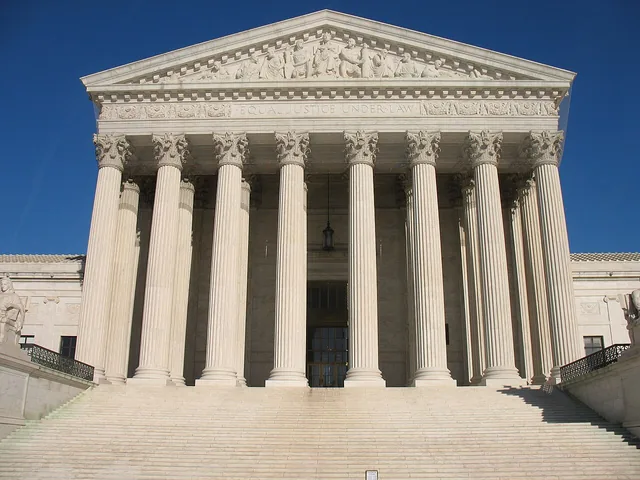
The Supreme Court on Monday let the Trump administration begin carrying out parts of an executive order on mail voting, in a 6-3 decision that took care to say it was not ruling on whether any of it is lawful. "The Court's disposition of this application does not mean that any measure taken by the Government to implement the Order will necessarily be lawful," the unsigned decision said. "On that score, time will tell." The reason the government won was jurisdictional: the order itself, the court held, does not harm the states, so the district court had no power to stop the government from trying to implement it.
The provisions at issue direct the Department of Homeland Security to build state-by-state lists of people eligible to vote, drawing on federal databases, and direct the Postal Service to handle mail ballots against its own voter-eligibility lists. The order was signed in March, and 23 Democratic-led states sued days later, arguing the president has no power over who may vote or over how they run federal elections. In June, Judge Indira Talwani agreed, holding that only the states set voter-eligibility requirements, and blocked the DHS and Postal Service provisions for the 3 November elections in those states. The First Circuit declined 2-1 to lift that block. Twelve Republican-led states had intervened on the administration's side, and the court granted their application too.
In the Supreme Court the solicitor general, D. John Sauer, did not argue that the president's plans were legal. He argued that the states had gone to court too soon, since the agencies were still working out how to carry the order out, and that their real complaint was with future actions nobody had taken yet.
Except that one agency had. On Friday, with the case still pending, the Postal Service published its final rule. It sets design requirements for federal mail ballot envelopes and tells state election officials to file data through an online portal, including the names and addresses of the voters they intend to send ballots to. On Election Day the Postal Service will send each state's chief election official a "Mail-In and Absentee Participation List" drawn from that data — meant, the rule says, to help election officials and law enforcement understand who may have been sent a ballot and spot anomalies worth investigating. The same rule says the Postal Service will play no part in deciding who is eligible, maintaining voter rolls, or counting ballots. The administration told the court the regulations went less far than the order envisaged, and that the Postal Service will not refuse to carry ballots for people who are not on a state list.
The three liberal justices dissented. Sonia Sotomayor, joined by Elena Kagan, wrote that the decision "merely postpones adjudication" and does not address whether the president's attempts to interfere with the states' administration of the November elections are lawful, nor suggest that the executive branch has any authority to implement his directives. Ketanji Brown Jackson wrote separately that the majority was "taking its eye off the ball" by answering a technical question, and described the administration's aim as securing the court's imprimatur for an effort to foment chaos before November.
The White House called the provisions commonsense measures and said it would continue to enact the agenda the president was elected on, "which includes the safety and security of our elections." New York's attorney general, Letitia James, called the ruling a painful setback that would not be the final word. California's governor said the state would sue again.
A separate order by the same judge still blocks parts of the executive order nationwide. NBC News reports that Monday's decision is likely to reach that ruling as well; CBS News puts it as something the Justice Department will argue. Some states begin posting ballots within weeks.
Why it is on the board
Fourth on NBC News's most-read list when we collected and eleventh on the New York Times's, with a clip on the ruling in the American video lens.
The two accounts we hold were built to different lengths and it shows in what each keeps. NBC News has the politics around the decision — the White House statement, the New York and California responses, and Jackson's separate dissent, which the CBS account does not carry. CBS News has the paperwork: what Talwani actually held in June, what the First Circuit did, and the text of the Postal Service rule that landed three days before the ruling.
확인: NBC News · CBS News